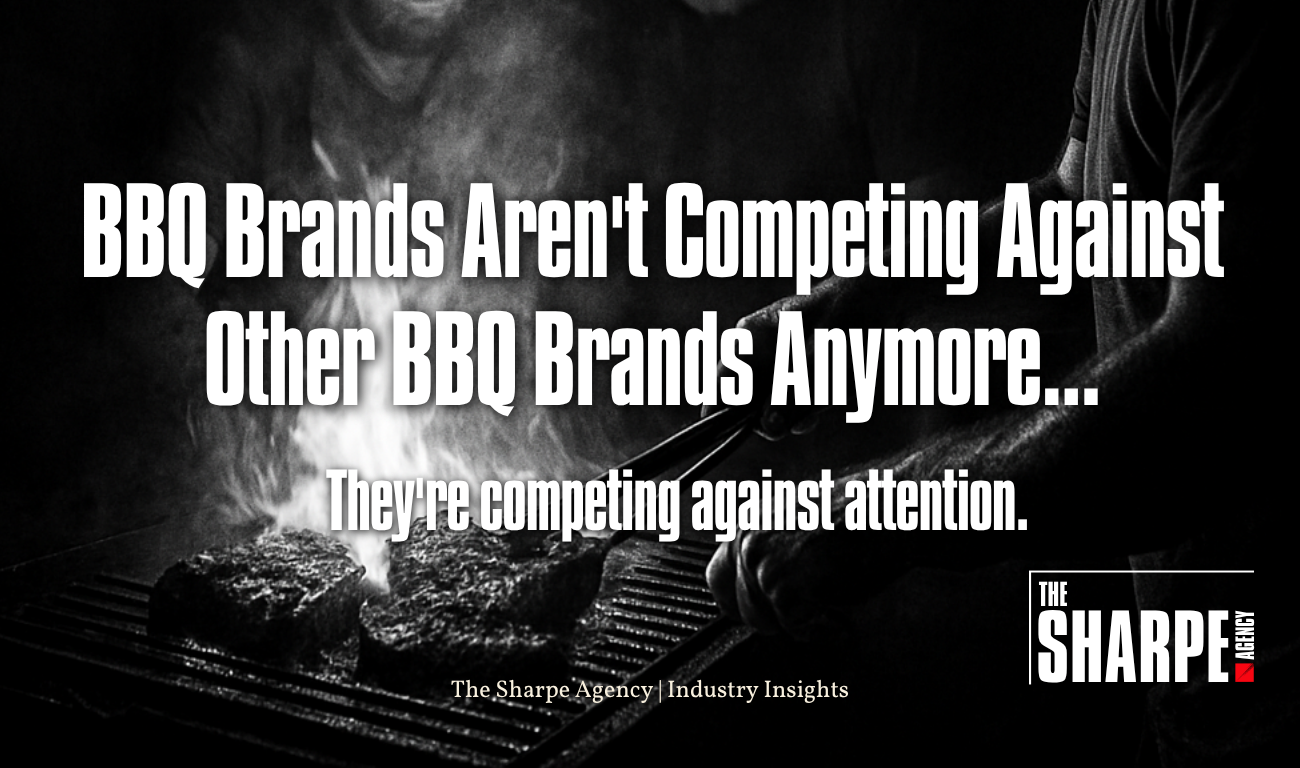
Most BBQ marketing looks like somebody panic-bought tactics at a trade show. A little Facebook, a little Google Ads, a few recipe posts, an influencer holding tongs like they’ve never cooked a steak in their life. Then everybody sits in a meeting wondering why sales plateaued.
Meanwhile, the brands actually winning in live-fire cooking, premium meats, grilling, and outdoor lifestyle are quietly building ecosystems. Not campaigns. There’s a real distinction there, and it’s the one most marketing teams refuse to admit they don’t understand.
At The Sharpe Agency we work directly inside the BBQ, outdoor cooking, and meat industries. We understand this category because we operate inside it, not because we Googled “how to market grills” five minutes before a client call. We’ve worked alongside some of the most influential voices in barbecue media and with premium meat-focused businesses serving deeply loyal audiences. That matters here because this industry behaves differently than most. BBQ customers aren’t casual buyers. They’re hobbyists, collectors, researchers, and community-driven obsessives who will spend three hours researching brisket internal temps before they’ll spend three minutes on your homepage. If your marketing still looks like disconnected social posts and the occasional sales graphic, your competitors are slowly cooking you alive.
The Industry Is Exploding. The Marketing Is Embarrassing.
The global barbecue grill market is on track to reach $7.77 billion by 2030, and that’s before you factor in outdoor kitchens, premium smoker adoption, pellet grills, premium meat subscriptions, or the genuinely absurd amount of BBQ content people now consume across YouTube, TikTok, Instagram, and streaming. Pellet grills alone are growing at nearly 7% CAGR. Demand is moving in every direction the marketing teams are not.
Yet most brand work in the category still feels stuck somewhere around 2012. Stock photography that looks rented, captions written by committee, discount-driven messaging that quietly trains customers to wait for the next promo, and the occasional “random act of content” posted because somebody on the team felt guilty about the calendar being empty.
The deeper problem is this. Consumers aren’t buying grills because of BTU output anymore. They’re buying identity. They’re buying the idea of being the house everybody comes to, the ritual, the confidence, the mastery, the lifestyle. Which means your competition is no longer just another grill company. Your competition is every creator, every recipe channel, every outdoor lifestyle brand, every meat subscription company, every influencer, and every piece of content fighting for the same eyeballs your audience has. That changes everything about how a serious brand in this space should be thinking.
Most Brands Don’t Have a Strategy. They Have Marketing Fragments.
Here’s where things usually fall apart. The website says one thing. Instagram says another. Email sounds like it was written by a corporate lawyer. TikTok sounds like an intern overdosed on caffeine. Retail messaging has no relationship to digital. Nothing feels connected, because nothing is. That isn’t omnichannel marketing. That’s a digital identity crisis with a content calendar.
Real omnichannel means the customer experience feels seamless whether somebody finds you through Google, watches a recipe video on YouTube, sees your smoker on Instagram, walks into a retailer, opens your emails, joins your community, buys premium meat online, or scans a QR code from packaging. Every touchpoint reinforces the same experience, because modern consumers expect continuity and quietly punish brands that don’t deliver it. The famous Harvard Business Review study of 46,000 shoppers found that omnichannel customers logged 23% more repeat visits within six months, spent more across every channel they touched, and were significantly more likely to recommend the brand to friends and family. Separately, Aberdeen Group has reported that brands with strong omnichannel engagement retain roughly 89% of their customers compared to 33% for those with weak strategies. Translation: the companies building connected ecosystems are printing money while everybody else argues over social media impressions in a Slack channel nobody respects.
Attention Is the Currency Now
This is the part most traditional agencies still refuse to internalize. You’re no longer marketing products. You’re competing for attention inside an algorithm-driven economy, which means content quality matters more than ever, and frankly, a lot of BBQ content is terrible. Overlit food photography that makes brisket look like leather, dry shots that should never have left the camera roll, recipe videos that feel like hostage footage, graphics overloaded with text, and the inevitable Fourth of July post that looks identical to every other brand’s Fourth of July post.
In this category, visuals matter, a lot. People really do eat with their eyes first. Your photography should feel cinematic, your videos should feel immersive, and your content should be the reason somebody puts their phone down and walks to the freezer. The brands dominating this space already know this. They build recipe ecosystems, educational libraries, real community engagement, long-form video, search-driven authority, personality-driven branding, email experiences people actually open, and membership programs that compound. The smartest brands in barbecue have stopped behaving like manufacturers. They behave like media companies that happen to sell hardware.
Search Is Quietly Eating This Category
One of the biggest mistakes we see in this space is brands wildly underestimating how much research the average BBQ consumer does before buying anything. These people search for everything. Best pellet grills, reverse sear technique, brisket timing, smoker reviews, prime rib at altitude, internal temps, competition methods, dry brining theory, Wagyu prep, grill comparisons that go six levels deep into engineering specs. The category is fundamentally built on education, which means search is not optional. It’s infrastructure.
The brands consistently winning organic traffic are building libraries of useful content that compound over time. Not just recipes. Authority. And authority matters because trust matters, and consumers are far more likely to buy from brands they’ve already learned something from. This is exactly why some of the most influential businesses in outdoor cooking have evolved from product sellers into full education platforms, media ecosystems, memberships, and community-driven experiences. The audience comes first. Revenue follows. The brands that flipped that order are mostly out of business or about to be.
The Future Is Ecosystem, Not Campaign
Most agencies still sell isolated tactics, which is exactly why so many companies waste six figures on marketing and still can’t tell you whether anything actually worked. Real growth comes from a connected ecosystem where SEO supports content, content feeds social, social builds community, community drives retention, retention fuels revenue, data sharpens every decision, email extends lifetime value, video earns authority, and paid media accelerates whatever’s already proven. That’s how modern brands scale, especially in enthusiast-driven categories like barbecue, grilling, and premium meats.
This is where The Sharpe Agency operates. We understand the psychology behind outdoor cooking audiences because we actively work inside these spaces. BBQ culture, meat marketing, consumer loyalty behavior, outdoor lifestyle branding, search-driven food content, community development, membership growth, live-fire education ecosystems, content monetization, omnichannel customer journeys. Most agencies cannot say that honestly, and the ones who try usually give it away in the first ten minutes of a pitch.
The Bottom Line
If your brand still runs on random content, disconnected campaigns, and the quiet hope that customers will magically stay loyal, the next few years are going to be uncomfortable. The brands winning right now are building authority, communities, experiences, and ecosystems. They create audiences before they create customers, and in this industry, the companies that own attention eventually own the market.
At The Sharpe Agency we help BBQ brands, meat companies, and outdoor cooking businesses build marketing systems that actually compound instead of restarting from zero every quarter. Good marketing should feel less like setting money on fire and more like controlling the temperature. Precise. Intentional. Built to last.
Ready to build a system that compounds? Book a strategy call with The Sharpe Agency
The Sharpe Agency Calculated Marketing. Executed Cleanly.