

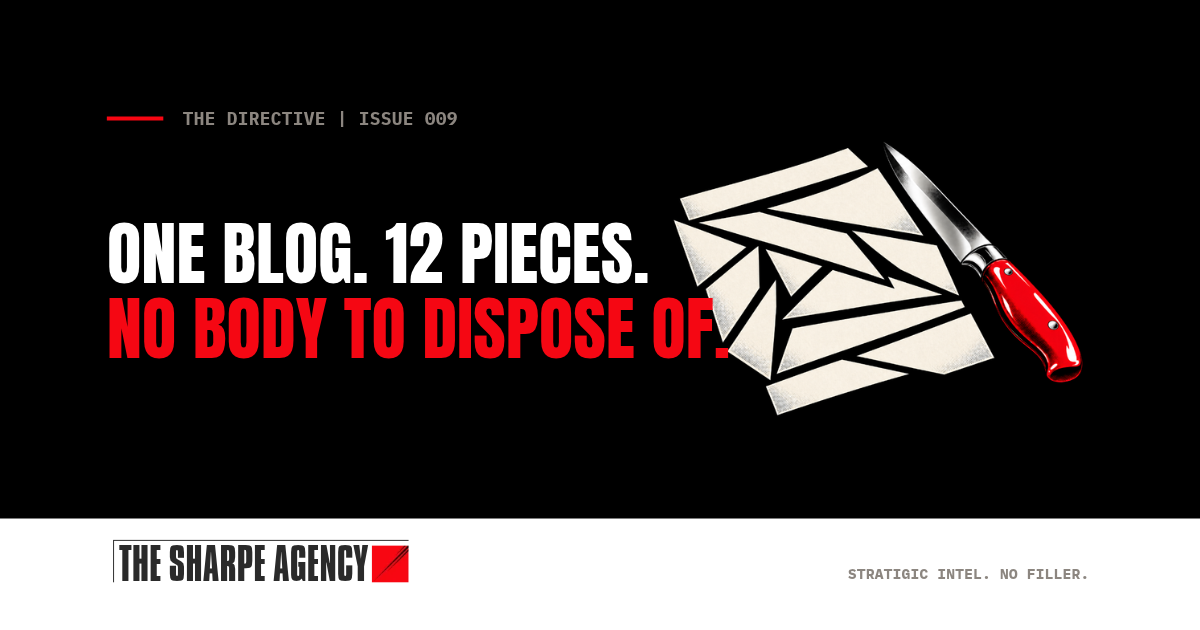
Think Dexter, minus the boat and the bin bags. Nobody’s disposing of a body here. We’re taking one blog post apart, piece by piece, and putting every part to work. That’s content repurposing. If you’re writing something new for every platform every week, this is what you’re missing.
One solid piece of long-form content can fill your social calendar, feed your email list and send traffic back to your website. A blog post works best, but a video, podcast or live works too. Less flailing. More cutting.
What Is Content Repurposing?
Content repurposing means adapting existing content into a different format, medium or context so it reaches a new audience or does a different job. A blog post becomes an email. A section becomes a Reel. One sharp line becomes a quote graphic.
Simply put: you already did the hard thinking. Repurposing makes sure it pays off more than once.
Why Repurposing Content Beats Starting From Scratch
- It saves hours. You write once and edit many times. Editing is quicker than staring at a blank page, and far less miserable.
- It keeps your message consistent. Your audience hears the same idea across every channel, which is how an idea actually sticks.
- It reaches people where they already are. Some people read blogs. Some only watch Reels. Some never leave their inbox. Repurposing reaches all of them without you having to run three separate businesses.
- It drives traffic back to your website. Every email and social post that links to the original blog sends people to the page built to rank and convert.
Work smarter, not harder. Everyone says it. Repurposing is how you actually do it.
How to Dissect a Blog Post Before You Repurpose It
Before you pick up the scalpel, know what you’re cutting. Read the post and pull out five parts:
- The core idea: the one-sentence takeaway. This becomes your email subject line and your Reel hook.
- The key points: every subhead or list item can stand on its own as a post or a carousel slide.
- The quotable lines: anything sharp enough to put on a graphic.
- The question it answers: good material for a group discussion or a poll.
- The call to action: where you want people to go next.
Those five parts are your raw material.
12 Ways to Repurpose One Blog Post
Here’s how I turn a single concept into 12 pieces of content, most weeks.
1. Email Newsletter
Write an email that covers the main talking points and sends readers back to the full blog. You get website traffic, a list that stays warm, and an opening for an upsell or a sale. Not bad for one email.
2 to 4. Facebook: Reels, Stories and Posts
- Reel: talk through the core idea in under a minute.
- Story: a poll or quick question pulled from the post.
- Post: a quote graphic or a carousel built from your key points.
5 to 7. Instagram: Reels, Stories and Carousels
The same three formats, adjusted for Instagram. For a carousel, put one key point on each slide, a sharp hook on slide one and a call to action on the last.
8. Facebook Group Engagement Question
Turn the question your blog answers into a discussion prompt. You’ll find out what your audience actually thinks, which is cheaper than a focus group and a lot more honest.
9. Pinterest Pin
Create a pin that links to the blog post, and to the podcast episode if you have one. Pinterest works like a visual search engine, so a good pin can keep sending traffic long after you’ve posted it.
10. LinkedIn Post
Rewrite the core idea as a short, opinionated post. LinkedIn is where a point of view earns its keep, so pick a side.
11. Short-Form Video for TikTok or YouTube Shorts
Reuse your Reel. Same video, different platform, a quick tweak to the caption. Upload the original file, not a copy carrying another app’s watermark.
12. Podcast or Live Talking Points
Use the blog as the outline for a podcast episode or a live. The structure’s already done, so all you have to do is turn up and talk.
And just like that, one blog post becomes a week’s worth of content. Hours saved. Bloody brilliant.
Should You Use AI for Content Repurposing?
Yes, on a short leash. AI is useful for the faff: pulling out key points, reformatting, resizing and suggesting hooks. It is rubbish at sounding like you. Your audience can smell AI slop from across the room, and so can we. Let AI do the sorting. You do the writing.
If you’re a purist, pen and paper works fine. Map out the post, list the pieces and give each one a day. Old school still works.
Content Repurposing Tips That Actually Matter
- Start with a strong post. Repurposing a weak blog just gives you twelve weak posts.
- Change the hook for each platform. Keep the idea the same and change the opening.
- Always link back to the original. The blog is home base, and everything else should point to it.
- Space it out. Spread the pieces across a week or two instead of posting them all on the same day.
- Follow blogging best practices so the original earns its keep in search: clear headings, a focus keyword, internal links and a genuinely useful answer.
Content Repurposing FAQs
What is content repurposing? It’s taking existing content, such as a blog post, video or podcast, and adapting it into new formats like emails, social posts and graphics, so it reaches more people.
How many pieces of content can you get from one blog post? Usually 12 or more, depending on how long the post is and how many standalone points it contains.
What content is best to repurpose? Long-form content with several distinct points: blog posts, podcast episodes, webinars and lives.
Is repurposing content bad for SEO? Not if you change the format. Turning an idea into an email, a Reel or a carousel doesn’t create duplicate content. If you republish the full article on another website, add a canonical tag pointing back to the original.
Remember Why You’re Blogging
Blogging drives engagement, builds SEO and grows your online presence. Repurposing makes sure every post works as hard as you did when you wrote it.
Not sure your content is pulling its weight? Let’s talk. Tell us what you’re working with and we’ll tell you where your marketing is leaking, and what to cut first.