
Most marketing doesn’t fall apart at the beginning, when everyone is excited and the ideas are flowing. It falls apart at the very end, in the last few seconds of an ad or the last line of an email; when your audience is paying attention, interested and possibly even ready, and nobody bothers to tell them what to do next. So they do what people always do when left to their own devices, which is close the tab and get on with their day.
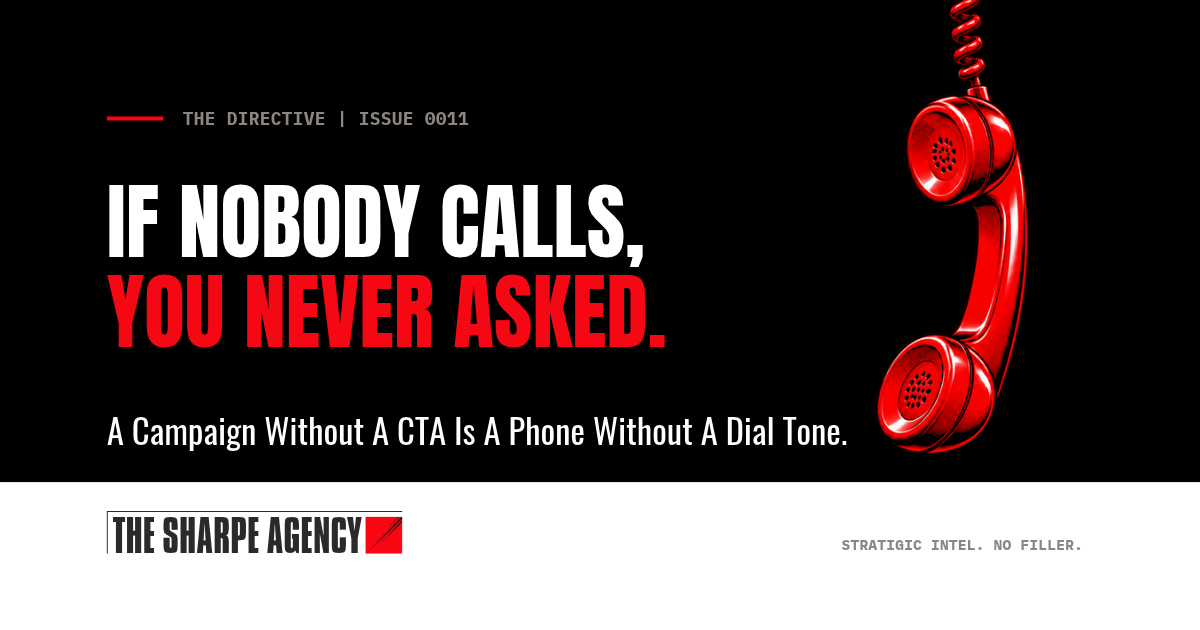
That moment is the job of your call to action (CTA), and it’s the part of marketing that businesses most often treat as an afterthought. A campaign without a call to action is a phone without a dial tone. Below is how we approach CTAs at The Sharpe Agency, and why we’ll happily spend more time on the few words at the bottom of a page than most people spend on the whole page.
1. Make Your Call to Action an Instruction
A strange politeness creeps into business marketing right at the point where it should be at its most confident. Brands that have spent paragraphs making a strong case suddenly go quiet and offer a timid “learn more,” as though asking for the sale might cause offense. Your audience doesn’t need hints. Instead they need you to be clear about what happens next and why it’s worth doing now, and a line like “Get Yours Before It’s Gone” does far more work than any amount of gentle nudging.
Sharpe Tip: Swap soft verbs like “try,” “consider” and “explore” for verbs that commit the reader to something: claim, book, start, get or grab.
2. What Happens to Business Marketing Without a CTA
When we review a new client’s marketing, the missing call to action turns up far more often than it has any right to, and usually on the pages that took the most effort to build. The message is clear, the audience is primed, and then the page simply ends, leaving people to work out the next step on their own, which most of them won’t bother to do. Every page, post, email and ad you publish should answer one question for the reader, namely what they should do now, and if it doesn’t, you’re paying to attract attention and then quietly letting it walk out the door.
Sharpe Tip: Urgency works, but only when it’s honest. “Offer ends Friday” is persuasive when the offer genuinely ends on Friday, whereas a fake countdown timer or an “only 2 left” banner on a fully stocked product will cost you trust, and it’s exactly the kind of trick regulators have started paying attention to.
3. Social Media CTAs: Nobody Owes You a Click
On social media, your CTA is up against memes, cat videos, breaking news and Susan’s unsolicited life advice, all served up on platforms that would generally rather keep people scrolling than send them off to your website. A polite “check this out” vanishes in that environment, so give people something specific to do that feels worth the effort, such as saving the post for their next launch, telling you about their worst marketing disaster, or commenting GUIDE so you can send something over. Keep the visual simple enough that the action is obvious at a glance, because a cluttered graphic with three competing messages tends to produce no action at all.
Sharpe Tip: Write the call to action for the platform it lives on. For example, on Instagram Stories that means a link sticker with a short, urgent line, on LinkedIn it means a question people actually want to answer. On X it means a few words and an easy repost, and on TikTok it means saying the action out loud in the video instead of burying it in the caption. Yes, we know, it can be laborious.
4. Ad CTAs: Stop Hiding Behind “Learn More”
“Learn More” is the button businesses reach for by default, for roughly the same reason landlords paint everything beige: it’s safe, it offends nobody, and nobody remembers it afterwards. Most ad platforms give you a fixed menu of buttons, so pick the one that matches what you actually want people to do, whether that’s Book Now, Get Quote or Sign Up, and let your headline carry the persuasion with something like “Get Your Free Quote Today” or “Grab Your Spot Before Friday.” Ads are your best chance to turn cold leads into warm ones, and a vague button is the quickest way to waste the money you spent getting their attention in the first place.
Sharpe Tip: Use retargeting to follow up with the people who looked and left. A simple “Still thinking about it?” paired with a genuine reason to act now will bring a fair few of them back, and winning back someone who already knows you is a great deal cheaper than finding someone new.
5. Your Brand Voice Belongs in Your Call to Action
A generic CTA undoes a lot of good work, because it’s the one line nearly everyone reads and it’s often the only line on the page that sounds like it was written by somebody else. If your brand is bold everywhere else, there’s no reason to go quiet at the moment that matters most, and “Let’s Make Some Trouble” will always be more memorable than “Contact Us,” provided trouble is what you’re actually selling. The same action can sound completely different depending on who’s asking:
| Brand voice | CTA |
|---|---|
| Classic and clean | Book a Consultation |
| Warm and friendly | Let’s Chat About Your Plans |
| Bold and cheeky | Let’s Make Some Trouble |
Sharpe Tip: Two to five words is usually plenty for the CTA itself, as long as every one of them is doing something useful.
6. Measure Your CTA Like It Owes You Money
A call to action is only a theory until the numbers say otherwise, so track clicks, conversions and what people do after they click, and treat the results with a healthy amount of suspicion. Heatmaps will show you whether people are even seeing your button or scrolling straight past it, A/B tests will settle arguments about wording, color and placement that would otherwise drag on for weeks, and your analytics will tell you whether the people who clicked went on to do anything useful.
Personalization is worth the effort as well. HubSpot analyzed more than 330,000 CTAs and found that the ones tailored to the individual visitor converted 202% better than generic versions, and the simplest place to start is showing returning customers something different from what you show first-time visitors.
Sharpe Tip: No CTA is ever really finished. Review it whenever your offer, your audience or your results change, and assume the version you’re running today can be beaten.
Call to Action FAQs
What is a call to action in marketing? It’s the part of your marketing that tells people what to do next, whether that’s buying, booking, signing up, downloading or replying, and it can take the form of a button, a link or a single line of copy.
What makes a good call to action? A good CTA is clear about the action, specific about what the reader gets, and gives them a reason to do it now instead of later, ideally in as few words as possible.
Where should a call to action go? Anywhere a reader might reasonably be ready to act, which usually means near the top of a landing page, at the end of every blog post and email, in every ad, and in your social captions.
How many CTAs should a page have? One main action per page is the safest rule. You can repeat that action several times on a long page, but give people too many different things to do and most of them will choose none of them.
The Final Cut
Most businesses put enormous effort into getting attention and then leave the most valuable moment, the one where somebody is finally ready to act, entirely to chance. Your call to action is the line that decides whether all that effort turns into revenue, so it deserves at least as much thought as the headline at the top of the page.
If you’d like a second pair of eyes on yours, let’s talk. We’re rather good at this.